


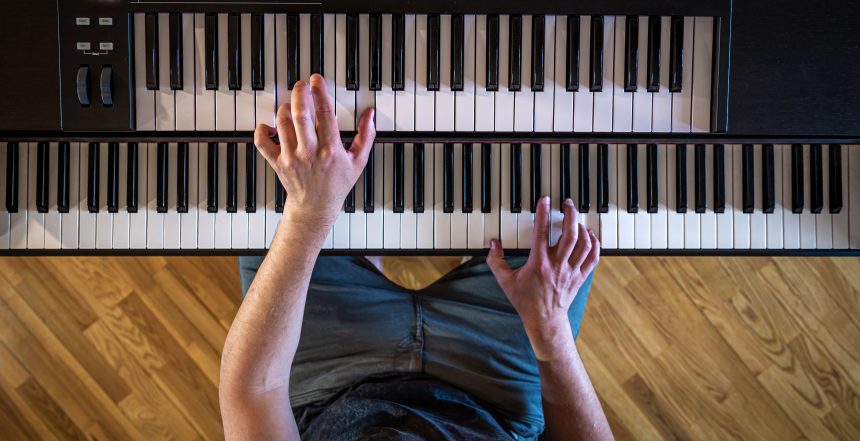
The piano keyboard remains one of the most recognizable and versatile musical interfaces in the world. Whether you’re sitting at a grand acoustic piano, practicing on digital pianos with weighted keys, or exploring a MIDI controller, the question almost every beginner asks is the same: how many keys on a piano? The standard modern answer is 88 keys—52 white keys and 36 black keys (also called black notes). This configuration has dominated keyboard instruments since the late 19th century and provides the full range needed for virtually all Western classical, jazz, pop, and contemporary music.
In this comprehensive guide we explore the exact number of piano keys, the logic behind the alternating black keys and white keys pattern, the role of music theory, the historical reasons for the 88-key standard, tuning systems, visual navigation tricks, common myths, and even how the layout connects to other instruments and musical traditions.
The Standard: 88 Keys Total (52 White + 36 Black)
A full-size acoustic or high-end digital piano contains exactly 88 keys:
- 52 white keys — These represent the seven natural notes (C, D, E, F, G, A, B) repeated across octaves.
- 36 black keys — These represent the five accidentals (sharps/flats) in each octave.
Together they span 7 full octaves plus a minor third at the low end (A₀ to C₈), giving the instrument a total compass of 7¼ octaves. This range—from the deep rumble of A₀ (27.5 Hz) to the crystalline sparkle of C₈ (4186 Hz)—covers virtually every pitch used in Western music.
For a clear labeled diagram showing all 88 piano keys, visit the excellent visual resource at Piano Keyboard Guide – 88-key layout with note names.
Why 88 Keys? Historical and Acoustic Evolution
Early keyboard instruments—such as harpsichords, clavichords, and the earliest fortepianos—had far fewer keys, often between 49 and 61. As composers demanded greater expressive range, manufacturers gradually extended the keyboard. By the 1880s Steinway, Bösendorfer, and other leading makers converged on 88 keys as the practical maximum.
Two main factors explain the limit:
- Musical frequencies and human hearing: Notes much lower than A₀ become inaudible rumbles; notes much higher than C₈ lose tonal clarity and become shrill.
- Practicality: Adding more keys increases cost, weight, string tension, and tuning difficulty with only marginal musical benefit.
Some concert grands (notably certain Bösendorfer Imperial models) feature 97 keys with extra sub-contra bass notes for richer sympathetic resonance, but these extra black keys and white keys are rarely played directly.
Yamaha offers a concise explanation of why the industry settled on 88 keys: Yamaha Musical Instrument Guide – Why pianos have 88 keys.
The Repeating Pattern: Seven White Keys + Five Black Keys per Octave
The piano keyboard repeats a 12-note pattern seven times (plus a short extension at the bottom):
- White keys = the seven notes of the C major scale → C D E F G A B
- Black keys = the five accidentals → C♯/D♭ • D♯/E♭ • F♯/G♭ • G♯/A♭ • A♯/B♭
This creates the familiar visual groups: black keys appear in sets of two and three, separated by white keys.
Finding Your Bearings: Landmark Navigation
The grouping pattern serves as a built-in GPS for the keyboard:
- Every group of two black keys has C immediately to the left.
- Every group of three black keys has F immediately to the left.
- Middle C (C₄) is usually the white key closest to the brand name/logo on most pianos.
These landmarks allow experienced players to orient themselves instantly—even in dim lighting or on unfamiliar instruments.
Beginners can practice this skill with the free interactive chart at Hoffman Academy – How to find notes on the piano keyboard.
Music Theory Foundations: Diatonic vs. Chromatic
The white keys alone produce the C major scale (or its relative A minor Natural Minor scale). This is the only major key and minor key that can be played entirely on white keys—no black keys required.
All other musical keys require some black keys because they contain one or more sharps or flats. The complete set of 12 semitones forms the chromatic scale:
C – C♯/D♭ – D – D♯/E♭ – E – F – F♯/G♭ – G – G♯/A♭ – A – A♯/B♭ – B – (C)
This chromatic scale is the foundation of Western music and is approximated by twelve-tone equal temperament, the dominant tuning system on modern pianos.
Tuning Systems and Temperament
Early keyboard instruments used various temperament systems:
- Pythagorean tuning — Pure fifths, but distant keys become unusable.
- Five-limit just intonation — Very consonant in a few keys, but unusable in others.
- Meantone temperament — Beautiful major thirds in common keys, but unusable wolf intervals elsewhere.
Modern equal temperament divides the octave into 12 geometrically equal semitones (each with a frequency ratio of ¹²√2 ≈ 1.05946). This compromise allows music to modulate freely through all musical keys—including remote ones on the circle of fifths—without retuning.
Why Are the Keys Colored Black and White?
The color scheme is both practical and historical:
- White keys (naturals) are visually dominant and easier to locate quickly.
- Raised black keys (accidentals) provide tactile and visual contrast.
- The pattern creates instant landmarks for keyboard navigation.
Early harpsichords and organs sometimes reversed the colors (black naturals, white accidentals), but the current convention became standard by the 18th century. Ivory was once used for key coverings on premium instruments (hence ivory keys), but modern pianos use synthetic materials.
Modes and Other Scales on the White Keys
Although C major and A minor are the only standard major/minor scales playable entirely on white keys, the same seven white notes also produce five additional diatonic modes:
- D Dorian
- E Phrygian
- F Lydian
- G Mixolydian
- B Locrian
These modes are widely used in jazz, folk, rock, and film scoring.
Extended Range: What Lies Beyond 88 Keys?
While 88 keys is the global standard for standard keyboard configurations, some instruments push the boundaries:
- Bösendorfer Imperial concert grands offer 97 keys (extra low bass notes).
- Rare experimental pianos have reached 108 keys.
Extra black keys and white keys below A₀ mainly add sympathetic resonance rather than new playable pitches.
Digital Pianos vs. Acoustic Pianos
Digital pianos almost always replicate the 88-key layout with weighted keys that simulate the feel of hammers striking strings. High-end models use graded hammer action, triple sensors, and samples from real concert grands. Even entry-level digital pianos usually include full 88 piano keys so students learn correct hand positions and range from day one.
Learning the Keyboard: Practical Tips for Beginners
- Locate middle C first—it’s your home base.
- Memorize the two black keys = C pattern and three black keys = F pattern.
- Practice saying note names aloud while playing slowly.
- Use piano lessons apps or piano teachers who emphasize aural skills and finger dexterity early.
- Explore Kodály rhythm language, rhythm vocab cards, relative rhythm cards, and finger plays to build foundational rhythm and pitch awareness.
For a complete beginner keyboard chart with labeled piano notes, see Piano Keyboard Guide – Printable piano keyboard diagram.
Famous Performances and Songs That Highlight the Range
Many iconic pieces exploit the extremes of the 88-key range:
- Amazing Grace (especially the arrangement by Wintley Phipps performed on Gaither Homecoming with Bill Gaither and Gloria Gaither) often showcases rich low B flat and high register.
- Classical works by Rachmaninoff, Liszt, and Prokofiev frequently demand the full compass.
Even blues harmonica players reference piano layout when discussing positions (e.g., diatonic C harmonica, minor harmonica, Lee Oskar harmonicas, Blues riff patterns, jam tracks, Cross-Eyed Cat by Muddy Waters).
Broader Musical Context: Harmonicas, Organs, and More
The piano’s keyboard system influenced many other instruments:
- Organ keyboards and organ keys often follow similar layouts.
- Fretless string instruments and certain synthesizers adopt comparable pitch spacing.
- Harmonica players mentally map their diatonic harmonica to piano white keys.
Conclusion: The Genius of 88 Keys
The 88-key piano keyboard—52 white keys and 36 black keys—is a near-perfect compromise between musical possibility, human physiology, and practical engineering. It enables every major key, minor key, mode, and chromatic passage in Western music while remaining physically manageable for adult hands.
Whether you are studying music theory, practicing piano notes, exploring the circle of fifths (or even the playful circle of sevenths), or simply enjoying the sound of Amazing Grace, those 88 keys remain the universal gateway to the piano’s infinite expressive potential.