

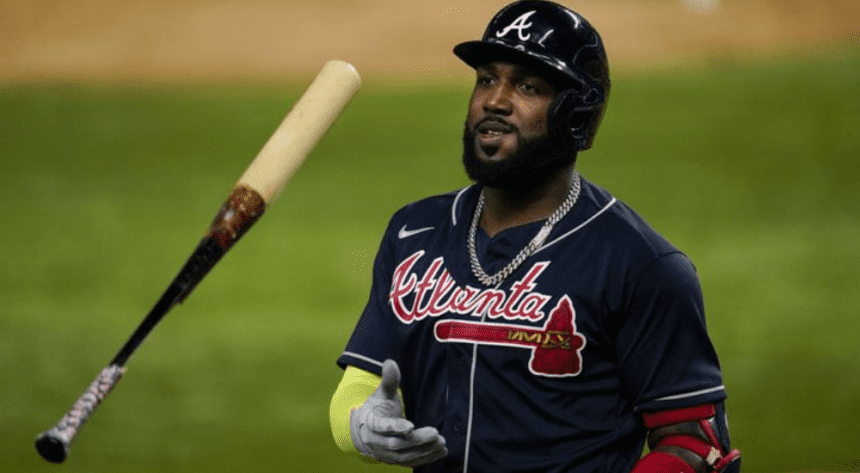
In the ever-evolving landscape of Major League Baseball, rumors can ignite fan discussions faster than a walk-off homer. One such headline that gained traction toward the end of the 2025 season—and lingered into early 2026 speculation—was whether the Atlanta Braves were seriously considering placing veteran slugger Marcell Ozuna on waivers. The idea of the Atlanta Braves waiving a player who had delivered back-to-back 39- and 40-home-run seasons just a year earlier seemed shocking at first glance. Yet, amid a disappointing campaign for the Braves, Ozuna’s declining production, nagging injuries, and looming free agency made the whispers feel plausible to analysts and frustrated fans alike.
As of March 2026, however, Ozuna never actually cleared waivers with Atlanta. Instead, after the Braves exercised his $16 million club option for 2025, they allowed him to enter free agency, where he signed a one-year, $12 million deal (with $10.5 million guaranteed and a $1.5 million buyout on a 2027 mutual option) with the Pittsburgh Pirates. The “waivers consideration” narrative stemmed largely from late-season speculation when Atlanta sat well out of playoff contention, looking to shed salary and create roster flexibility under new manager Walt Weiss.
This article dives deep into the rumor’s origins, Ozuna’s full career trajectory, his six-year tenure with the Braves, the specific factors fueling waiver talk, what the MLB waivers process would have entailed, the actual outcome, and the ripple effects for both Atlanta and Pittsburgh heading into 2026. We’ll examine stats, front-office strategy, fan reactions, and expert analysis to paint a complete picture of one of baseball’s most polarizing veteran sluggers.
Marcell Ozuna: From Dominican Prospect to MLB Powerhouse
Marcell Ozuna’s journey began in Santo Domingo, Dominican Republic, where he was born on November 12, 1990. Signed by the Miami Marlins as an international free agent in 2008, Ozuna climbed through the minors with raw power and athleticism that hinted at stardom. He debuted in the majors in 2013 at age 22, showing flashes of brilliance but struggling with consistency early on.
By 2017, Ozuna had arrived. That year with the Marlins, he posted a career-best .312 batting average, 37 home runs, 124 RBI, and a .924 OPS, earning All-Star honors, a Gold Glove in left field, a Silver Slugger, and 15th place in NL MVP voting. His combination of elite exit velocity, plate discipline, and defensive range made him one of the game’s most complete outfielders.
A trade to the St. Louis Cardinals in 2017 brought new challenges. Ozuna delivered solid but not superstar numbers in 2018-19 (.280/.325/.433 slash in 2018; 29 HR in 2019), though injuries and a more pitcher-friendly park limited his explosiveness. Then came the pivotal 2020 offseason move that changed everything: Ozuna signed a one-year, $18 million deal with the Atlanta Braves ahead of the COVID-shortened season.
That decision paid immediate dividends. In 60 games, Ozuna slashed .338/.431/.636 with 18 home runs and 56 RBI, leading the NL in several categories and winning the Silver Slugger for DH—the first-ever for the position in the National League under universal DH rules. His WAR of 2.8 that year underscored his value. The Braves loved the fit so much they re-signed him to a four-year, $65 million extension in February 2021, with club options that would keep him in Atlanta through at least 2025.
Ozuna’s early Braves years weren’t all smooth. A 2021 suspension for violating MLB’s domestic violence policy limited him to 48 games, where he hit just .213 with a dismal 70 OPS+. In 2022, he rebounded somewhat with 23 home runs but posted a career-worst .226 average and negative WAR. Critics questioned whether his best days were behind him at age 31. Yet Ozuna silenced doubters in spectacular fashion starting in 2023.
For a full statistical deep dive into Ozuna’s career—including year-by-year breakdowns and advanced metrics—check out his Baseball-Reference player page.
The Peak Years in Atlanta: 2023-2024 Dominance
Few players embodied the Braves’ offensive renaissance like Ozuna did from 2023 onward. After two subpar seasons, he returned to form with vengeance. In 2023, Ozuna played 144 games, slashing .274/.346/.558 with a career-high 40 home runs, 100 RBI, and a 140 OPS+. He finished 19th in NL MVP voting and helped power Atlanta to another NL East title. His 40 long balls tied him for the team lead and contributed to one of the most prolific power lineups in franchise history.
The 2024 season was even better. At age 33, Ozuna delivered a masterpiece: .302 average, 39 home runs, 104 RBI, .925 OPS, and a 154 OPS+—his best since 2020. He earned his third All-Star nod, finished fourth in NL MVP voting, and became the everyday DH who anchored a lineup decimated by injuries to stars like Ronald Acuña Jr. and Spencer Strider. Ozuna’s 162 games played showed remarkable durability, and his .378 on-base percentage reflected improved plate discipline.
Braves fans and analysts alike hailed him as a clubhouse leader and clutch performer. In the postseason, however, results were mixed—Ozuna’s bat went cold in key series, but his regular-season production was undeniable. Over his six seasons in Atlanta (2020-2025), he accumulated 148 home runs, a .265/.347/.489 slash line, and 11.2 WAR, cementing himself as one of the most productive DHs in franchise history.
These peak years made the subsequent 2025 struggles—and the resulting waiver speculation—all the more surprising. As one Wikipedia overview of Ozuna’s career notes, his trajectory mirrored many veteran sluggers: elite power phases followed by injury-related dips that force tough organizational decisions.
The 2025 Season: Injury, Decline, and the Seeds of Waiver Rumors
The 2025 campaign started promisingly for Ozuna. Through April, he hit .283 with a .915 OPS, looking every bit the 39-HR threat from the prior year. May remained solid at .277/.851 OPS. But a nagging hip injury—sustained early in the year—began to erode his bat speed and contact quality. By June, his average plummeted to .188 with a .550 OPS. A brief August resurgence (.255/.949 OPS, five homers in two weeks) gave hope, but inconsistency returned. September saw .261 with six homers, yet overall numbers cratered.
Final 2025 line: .232/.355/.400, 21 HR, 68 RBI in 145 games, .756 OPS, and 113 OPS+ (still above league average but a far cry from prior dominance). He struck out 144 times while walking 94 times, showing patience but diminished thump. The hip tear clearly impacted his ability to drive the ball, as his slugging percentage dropped 146 points from 2024.
With the Braves out of contention by midsummer, front-office eyes turned toward 2026 flexibility. Ozuna was in the final year of his deal (after the club exercised the 2025 option), making him a potential salary dump. Bleacher Report and other outlets floated the idea of waivers to save roughly $5-8 million in payroll while opening the DH spot. The team sat about $8 million under the luxury tax, and shedding even a portion of Ozuna’s remaining salary could fund upgrades elsewhere.
As Heavy.com detailed in their October 2025 prediction, Ozuna was viewed as a “sneaky waiver-wire addition” for contenders needing a right-handed DH. Similar buzz appeared in reports dubbing him a cost-cutting waiver candidate. These reports weren’t baseless speculation—they reflected real front-office calculus when a veteran’s production no longer matched his paycheck.
Breaking Down the MLB Waivers Process: What “Considering Waivers” Really Means
For those unfamiliar, MLB’s waiver system is a procedural safeguard designed to give all 29 other teams a chance to claim a player before he can be traded or outright released. When a team places a player on revocable waivers (typically 40-man roster players), any club can claim him within 48 hours (or 24 in some windows). If claimed, the claiming team assumes the full remaining contract. If multiple claims occur, priority goes by reverse order of standings.
If unclaimed, the original team can pull the player back, trade him (with salary relief often involved), or designate him for assignment—potentially leading to outright release. For Ozuna, a $16 million annual salary (prorated) made outright claims unlikely unless a contender desperately needed power and accepted the financial hit. The Braves could have used waivers strategically to gauge interest without committing to a release that would still owe him the full amount.
Analysts noted potential suitors: playoff-hungry teams might have rolled the dice if healthy Ozuna resurfaced. But the hip concerns and age (35 by 2026) deterred most. As explored in various outlets, the rumor highlighted broader Braves strategy—prioritizing youth and versatility over expensive veterans in decline. One piece captured the sentiment perfectly: why not test the market when the luxury-tax buffer allowed flexibility?
The Actual Outcome: Free Agency, Pirates Signing, and Braves’ New Direction
Ultimately, no waivers were needed. Ozuna reached free agency after 2025 and quickly found a new home. On February 9, 2026, reports emerged of a Pirates agreement; the deal was finalized February 16 for one year at $12 million (with incentives up to $500K for awards like MVP, All-Star, or Silver Slugger). The contract includes a 2027 mutual option at $16 million with a $1.5 million buyout—essentially a prove-it deal tailored for a bounce-back candidate.
Braves president of baseball operations Alex Anthopoulos explained the decision candidly. “He was great in April and May, but the hip injury impacted his year,” Anthopoulos said. New manager Walt Weiss wanted the DH slot open for lineup flexibility—rotating players like catchers or corner infielders without sacrificing offense. “When Marcell is hitting 39-40 homers… those are easy to carry,” Anthopoulos noted, “but the roster just made more sense with that slot open.” For the full context, read the SI.com breakdown of Anthopoulos’ comments.
The Pirates, meanwhile, viewed Ozuna as a perfect middle-of-the-order bat alongside new additions like Brandon Lowe and Ryan O’Hearn. As detailed in the official MLB.com announcement of the signing, Pittsburgh designated outfielder Jack Suwinski for assignment to clear 40-man space. Incentives in the deal—$250K for MVP, $50K for All-Star—show Pittsburgh’s belief in a resurgence.
For Braves’ 2026 DH plans, the organization turned to internal options and lower-cost additions, as outlined in MLB.com’s offseason coverage of Atlanta’s offensive needs. Early spring training reports suggest the open DH spot has already created opportunities for younger bats.
Impact on Both Franchises Heading Into 2026
For the Braves, moving on from Ozuna represents a calculated risk. Losing a proven 30+ HR threat hurts, especially after injuries plagued the 2025 lineup. Yet the financial savings and flexibility align with a “win-now” window that still includes Acuña, Matt Olson, and a deep pitching staff. Early 2026 projections show Atlanta competing for the NL East, banking on health and internal development rather than a declining veteran.
Ozuna’s departure also frees Atlanta from any lingering hip concerns that could have lingered into 2026. Fan reactions were mixed—some praised the business decision, others lamented losing a fan favorite who delivered memorable moments like walk-off homers and clutch RBI. Ozuna himself bid farewell in a heartfelt social media post, as covered in Yahoo Sports.
In Pittsburgh, Ozuna arrives as a low-risk, high-upside addition to a Pirates team building around Paul Skenes and young talent. At 35, he’s no longer a long-term cornerstone, but a motivated Ozuna could deliver 25-30 homers and stabilize the DH role. Spring training updates suggest he’s healthy and motivated, with Pirates brass citing his experience as a mentor for younger hitters. Contract incentives further align his goals with team success, per details in MLB Trade Rumors.
Legacy and What the Future Holds
Marcell Ozuna’s Braves chapter closed without the drama of waivers or a messy release. Instead, it ended with mutual respect and a graceful transition. His 148 homers in Atlanta rank among the franchise’s top DH contributions, and his 2023-2024 peak helped sustain contention during injury-plagued years.
Looking ahead, Ozuna’s 2026 performance with the Pirates will determine whether this was a smart prove-it deal or the beginning of the end. For the Braves, the open DH experiment could unlock unexpected production or force midseason adjustments. Either way, the “waivers consideration” rumor served as a microcosm of modern MLB economics: even productive veterans face scrutiny when production dips and contracts expire.
In the end, baseball moves on. Ozuna gets a fresh start in Pittsburgh, while Atlanta bets on youth and versatility. The rumor that once dominated Braves Twitter now feels like ancient history—but it offered a fascinating window into how front offices navigate aging sluggers in today’s game.
Whether Ozuna rebounds to All-Star form or the Braves’ flexibility pays dividends, one thing is certain: the veteran slugger’s story remains far from over. Fans of both teams will watch closely as the 2026 season unfolds, remembering the power and passion Marcell Ozuna brought to every at-bat.